
Leadwork
Expert lead flashing, valleys & roof detailing across Surrey & the South East
Precision Roofing, Perfect Results
Traditional leadwork, built to last
Lead has been used in British roofing for centuries, and for good reason. When it is correctly installed, a lead detail can outlast the roof around it by decades. When it isn't, a small gap at a flashing or valley can quietly let water in for months before the damage becomes visible.
At Crown Roofing & Leadwork, leadwork is not an afterthought. It is a core part of what we do. Our team carries out traditional hand-crafted leadwork on homes, extensions, and renovation projects across Surrey, Berkshire, Greater London, and the wider South East, working to the standards set out by the Lead Sheet Association (LSA) and British Standard BS EN 12588.
Whether you need a lead flashing replacing, a valley lining repaired, or a full lead-covered bay or dormer, this page explains what is involved, what to expect from a reputable contractor, and how to spot the signs that your leadwork needs attention.
What is leadwork and why does it matter?
Leadwork is the use of sheet lead to seal and weatherproof the joints, junctions, and transitions on a roof. These are the places where two surfaces meet, where a roof meets a wall, where two roof slopes form a valley, where a chimney stack rises through the roof covering, or where a dormer window interrupts the slope.
These junctions are structurally the most vulnerable points on any roof. Without a reliable weatherproof seal, water will find its way in. Over time this causes rot, damp, and structural damage that is expensive to repair.
Lead is the material of choice because it is highly malleable, extremely durable (50–100 years when properly installed), resistant to corrosion, and compatible with most other roofing materials including tiles, slate, GRP, EPDM, and masonry. Where alternative materials like flashing tape or mortar fillets are used to cut costs, these typically fail far sooner and don't offer the same quality of seal.
Where is leadwork used on a typical home?
Most properties have leadwork in several locations. The most common applications we work on are:
Chimney Flashings
The junction between a chimney stack and the roof slope requires lead on four sides: a back gutter, stepped side flashings, and an apron at the front. Any failure here causes water to track down the inside of the chimney breast.
Valleys
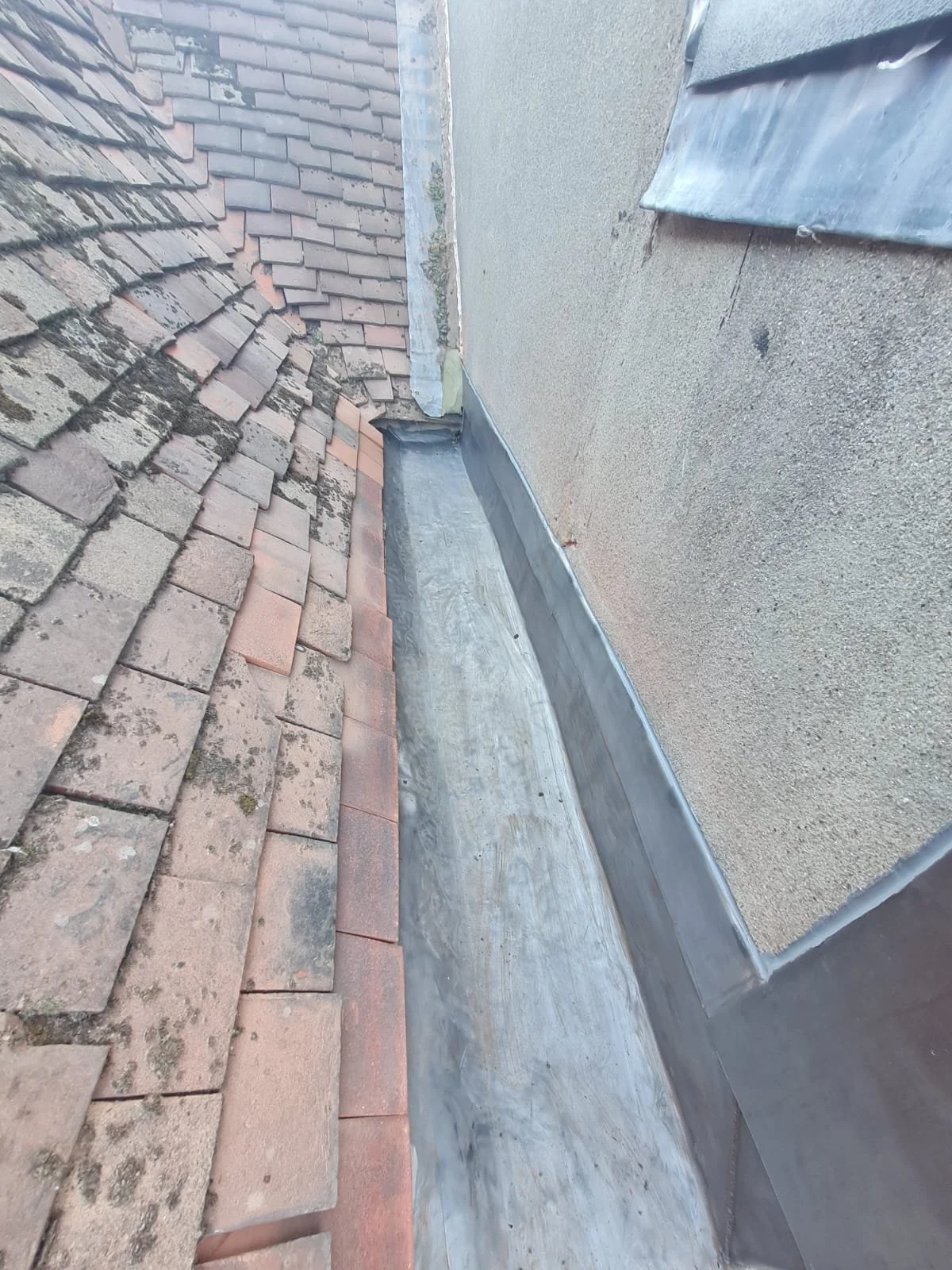
Where two roof slopes meet at an angle, water concentrates in the valley. Lead-lined valleys handle this load reliably — mortar or fibreglass alternatives are far less durable.
Dormer Windows
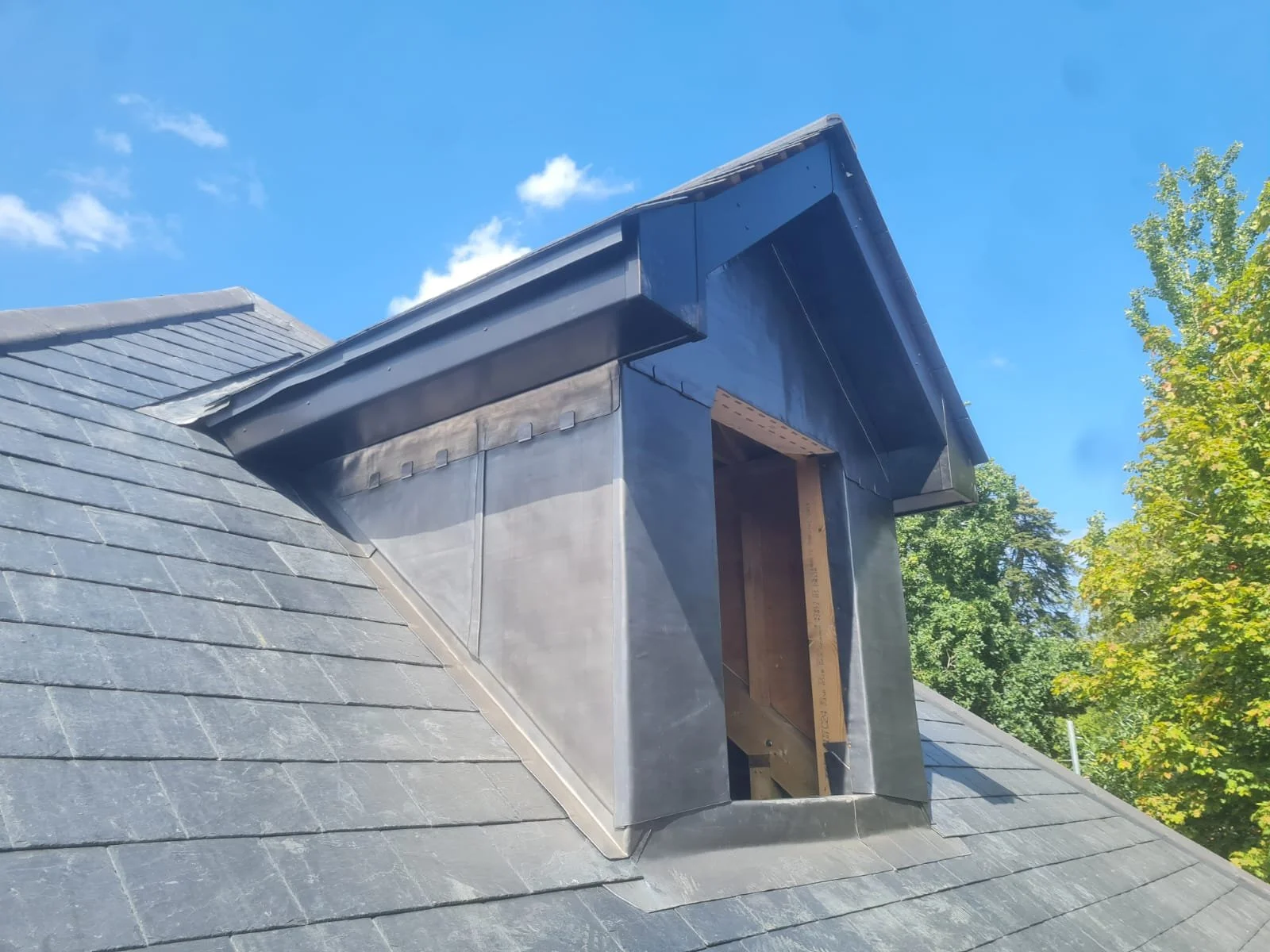
Dormers have multiple leadwork details — cheeks, roof, and the junction with the main slope — requiring careful detailing, particularly on older properties.
Flat Roof Abutments
Where a flat roof meets a vertical wall, a lead flashing forms a weathertight seal. Failures here are a common source of damp on internal walls.
Bay Roofs
Lead-covered bay roofs are common on Victorian and Edwardian homes, often developing leaks at the edges or where the lead has cracked from thermal movement.
Parapet Gutters & Box Gutters
Lead-lined internal gutters behind parapet walls are hidden from view and can deteriorate without obvious external signs.
Lead sheet codes explained
Sheet lead is graded by thickness and weight, described in 'codes'. The code used should be matched to the specific application, using undersized lead is one of the most common causes of premature failure.
Code 3
1.32mm
The lightest grade. Occasionally used for soakers under roof slates where cover flashings protect it from direct exposure.
Code 4
1.80mm
The standard grade for flashings, soakers and smaller details — step and cover flashings, chimney aprons, and most flashing applications.
Code 5
2.24mm
Used for chimney back gutters, valley gutters, and wider cover flashings where greater thickness improves durability.
Code 6
2.65mm
Appropriate for parapet gutters, valley linings, and wider flat roof details where longer service life is a priority.
Codes 7 & 8
3.15mm+
The heavier grades, used on larger flat roofs, heritage properties, and architectural applications where lead is an exposed feature.
Signs your Leadwork needs attention
Leadwork issues are often invisible from ground level until water damage has already occurred. A periodic inspection, particularly after severe weather, is the best way to catch problems early. Look out for:
-
Damp patches on ceilings or walls near a chimney, dormer, or roof junction
-
Cracking, lifting, or splits in the lead, usually caused by oversized sheets fatiguing from thermal movement
-
Mortar or sealant fillets at a flashing joint, a sign of a previous temporary fix
-
Lead pulling away from the wall or brickwork, allowing water in behind
-
White powdery residue (lead carbonation), normal weathering, but worth noting if accompanied by cracking
-
Moss or plant growth at valley or gutter junctions, indicating debris and standing water
How long does lead flashing last?
Correctly installed sheet lead, using the right code and following LSA best practice for joint details and maximum sheet sizes, can easily last 50 years or more. Some leadwork on older properties has been in place for well over a century.
Correct Specification
Right code, max bay lengths (~1.5m), and watertight joints
Quality of Installation
Poorly formed joints, inadequate fixings, and sealant-as-seal all reduce lifespan
Maintenance
Keeping valleys and gutters clear so water drains freely
The leadwork on many properties fails not because lead is unreliable, but because the installation wasn't carried out to the correct standard, particularly common where lead details have been bodged over previous repairs or replaced with cheaper alternatives.
Lead flashing vs. lead alternatives
Which is best?
| Lead | Mortar Fillets | Butyl Tape | Lead-Effect Aluminium | |
|---|---|---|---|---|
| Typical Lifespan | 50–100+ years | 5–10 years | 10–15 years | 20–30 years |
| Relative Cost | Medium–High | Low | Low–Medium | Medium |
| Malleability | High | None | Low | Medium |
| Heritage Suitable | Yes | No | No | Limited |
Lead Flashing Replacement (Single Chimney)
£400–£900
Valley Lining Repair / Replacement
£300–£700
Bay Roof Re-leading
£400–£800
Dormer Leadwork
from £600
Costs above are indicative ranges for the South East market. A survey is always needed before a fixed price can be given.
Our approach to Leadwork
At Crown Roofing & Leadwork, leadwork is central to what we do, it is in our name because it is genuinely a specialism, not a side service.
Every leadwork project we carry out is done by hand, to LSA guidelines, using the correct code of lead for the application. We do not use sealant as a primary seal, and we do not use undersized sheet bays to cut material costs. When we replace a flashing, we remove any previous temporary repairs, prepare the surface properly, and install to a standard that is intended to last.
We work across Surrey, Berkshire, Greater London, Buckinghamshire, East Sussex, Hampshire, and West Sussex, on everything from a single chimney flashing on a Victorian terrace to full leadwork packages on new-build extensions and renovation projects.
All of our work is fully insured, and we offer a minimum 10-year workmanship guarantee on new leadwork installations.
Leadwork FAQs
-
The most common signs are damp patches on ceilings or walls near a chimney, dormer, or junction point. You may also notice water staining on external masonry, or see the lead lifting, cracking, or pulling away from the wall if you can safely view the area. If you are not sure, a free survey will confirm whether there is a problem and what the cause is.
-
In some cases, yes. If the lead itself is in good condition and the issue is a single lifted section or a lost fixing, a repair may be all that is needed. However, if the lead has cracked due to thermal fatigue, or if a previous bodge repair is in place (such as a mortar fillet or sealant), the right course of action is usually to remove the old material and replace it properly. A repair on top of a failing detail simply delays the same problem.
-
No, in fact, lead flashing is particularly suited to older properties. It is the material that was used historically on Victorian, Edwardian, and Georgian homes, and it is still the best option for properties of this type today. The malleability of lead allows it to be worked around the irregular masonry and roof geometries that are common in period properties.
-
Yes. We have experience working on older and heritage properties where traditional materials are required. If a property is listed or in a conservation area, the specification of materials is often prescribed, sheet lead to the appropriate code is usually the requirement, and this is what we work to as standard.
-
A single chimney re-flashing is typically a half to full-day job. A valley replacement or bay re-leading usually takes one day. More complex work such as full dormer leadwork may take two days or more depending on scope. We will give you a realistic timeframe as part of the quote.
-
Not usually. Most leadwork is external and does not require internal access. The exception would be if we need to assess water damage or investigate a leak source from inside, in which case we would agree this with you beforehand.